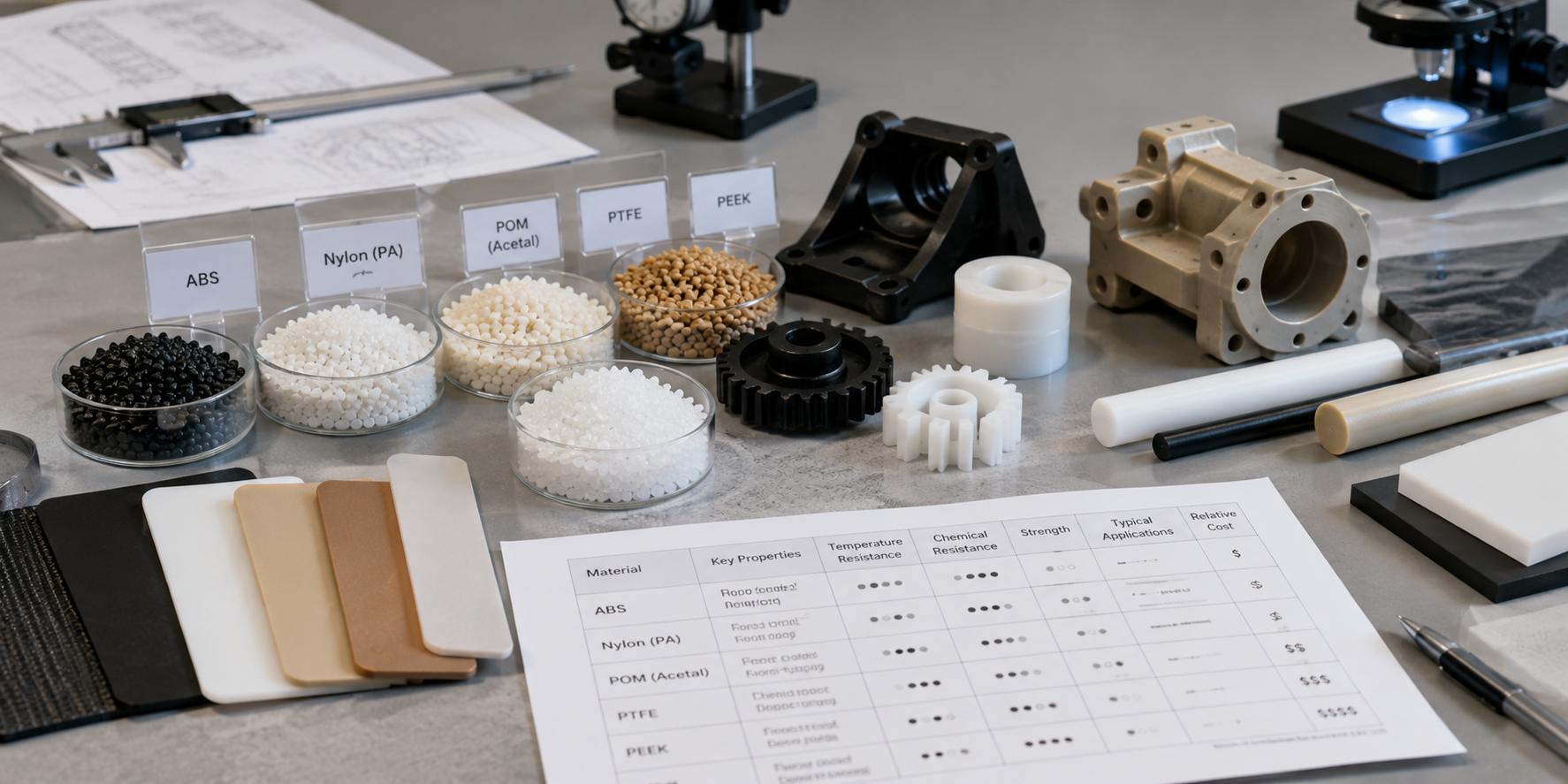
Engineering plastics cover a wide range of performance levels, from low-cost enclosures to high-temperature structural components. Picking the right resin requires a disciplined look at what the part actually has to survive.
The best material decision usually comes from narrowing requirements in sequence: load, environment, compliance, appearance, and budget. Skipping this process often leads to expensive overdesign.
Define the service environment first
Temperature, humidity, UV exposure, chemicals, and sterilization cycles all change which resins are viable. A material that performs well on a benchtop may fail quickly in outdoor, medical, or chemical-contact conditions.
Environmental demands should therefore eliminate candidates before you compare price or aesthetics.
- Confirm continuous and peak operating temperature.
- Map chemical contact, cleaning methods, and UV exposure.
- Check whether regulatory or flame requirements apply.
Match stiffness, toughness, and stability
Different polymers solve different mechanical problems. Some excel in impact resistance, others in stiffness, creep resistance, or dimensional stability across temperature swings.
Glass-filled grades, lubricated grades, and high-performance polymers can help, but they also change moldability, finish, and wear behavior.
- ABS and PC blends suit many housings and consumer assemblies.
- Nylon and POM are strong candidates for wear and moving parts.
- PEEK and PPS become relevant when heat and chemistry are extreme.
Balance performance with total cost
The cheapest resin on a per-kilogram basis is not always the lowest-cost choice if it creates scrap, warpage, or field failures. At the same time, premium polymers should only be specified when lower-cost materials truly cannot meet requirements.
Material selection works best when design, tooling, procurement, and quality teams evaluate the full manufacturing impact together.
- Consider yield, cycle time, and moisture handling in addition to resin price.
- Use backup resin options where the design can tolerate substitution.
- Run early molding trials for parts with tight dimensional demand.