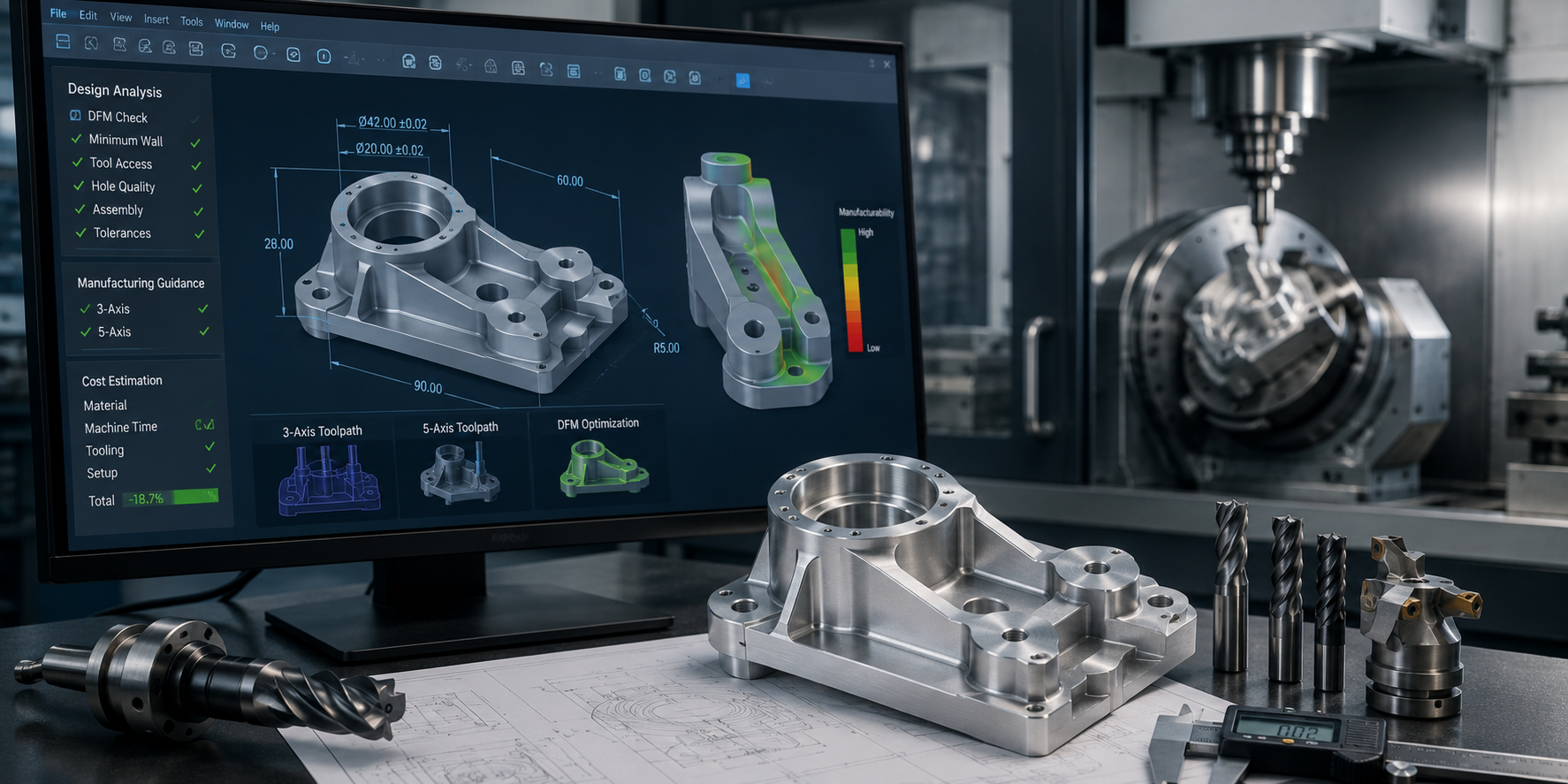
Good CNC design is not about removing every manufacturing constraint from the drawing. It is about making the part easy to fixture, easy to reach with standard tools, and easy to inspect without compromising function.
When designers understand how shops think about setups, cutter reach, workholding, and inspection flow, they can prevent cost from being baked into the model long before the first quote arrives.
Design around setups and tool access
Every additional setup adds time, stack-up risk, and cost. If the part can be completed from fewer orientations, it will usually machine faster and hold relationships more consistently.
Deep narrow pockets, sharp internal corners, and hidden undercuts force specialty tooling or extra operations. Standard end mills and clear tool approach paths are your friends.
- Prefer generous internal radii over sharp corners.
- Limit pocket depth-to-width ratios where possible.
- Combine features onto reachable faces to reduce repositioning.
Use tolerances strategically
Not every dimension deserves the same tolerance band. Tight tolerances slow production, increase inspection burden, and can force process changes that do not improve functional performance.
Apply precision where interfaces, sealing surfaces, bearings, or alignment require it, and relax cosmetic or non-critical dimensions whenever function allows.
- Flag critical-to-function dimensions explicitly.
- Use GD&T where relationships matter more than raw coordinate dimensions.
- Avoid defaulting whole drawings to the tightest block tolerance.
Match material and finish to the process
Material choice changes cycle time, tool wear, and achievable surface condition. A geometry that is easy in aluminum may be slow and expensive in stainless or titanium.
Finishes should be selected with the machining process in mind as well. Some cosmetic expectations are more economical when achieved through blasting, anodizing, or post-processing rather than additional machining passes.
- Review machinability early when choosing alloys or plastics.
- Call out only the surfaces that need premium cosmetic finish.
- Coordinate coating thickness with tolerance-sensitive features.