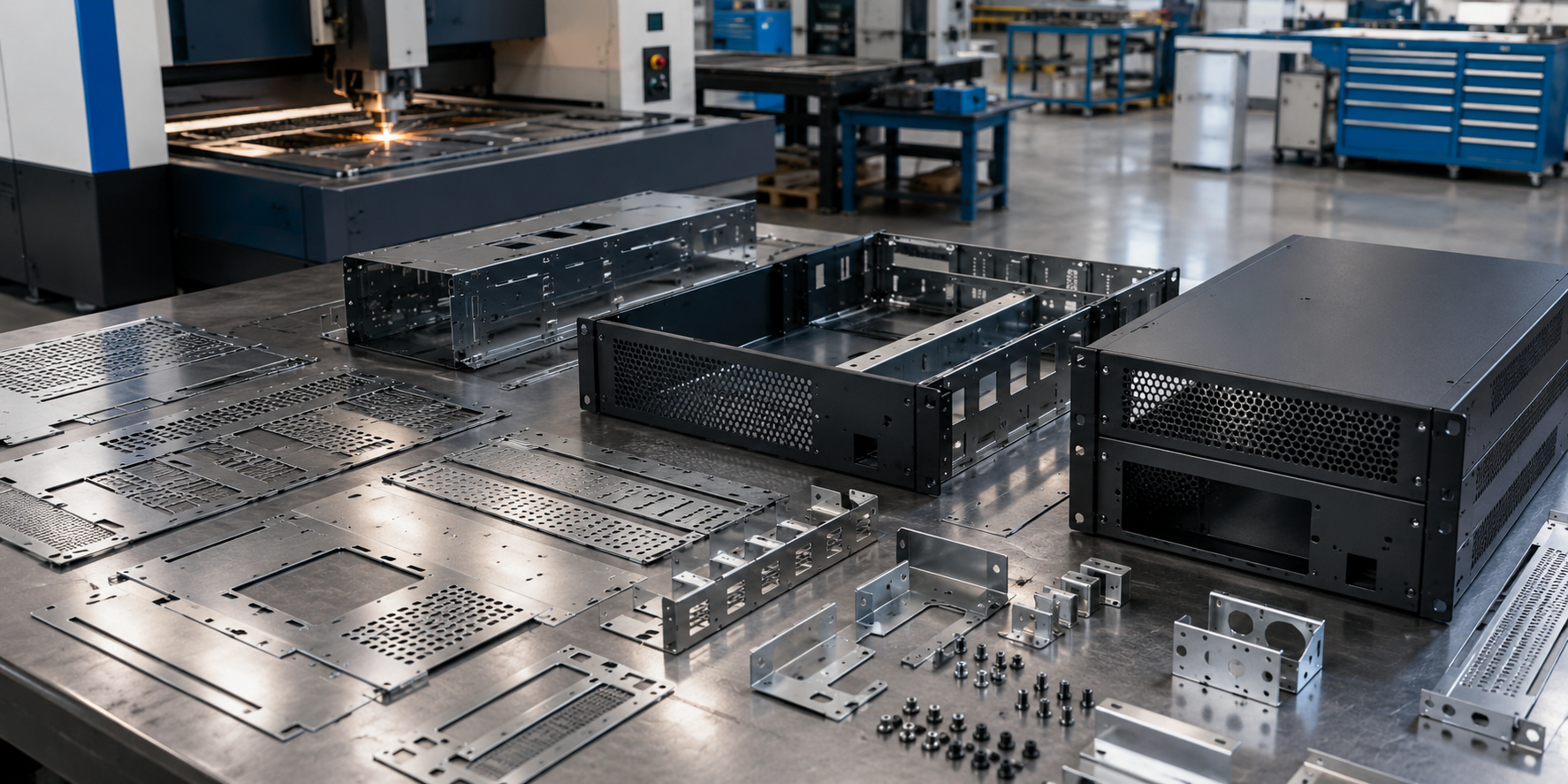
Fabricated electronics enclosures often look straightforward until assembly begins. This program involved a server rack chassis where dimensional accumulation across multiple formed and finished elements could easily have created installation issues.
The real requirement was not just making parts, but controlling relationships so the complete enclosure system behaved predictably.
Solution Snapshot
We coordinated cutting, bending, hardware insertion, and finishing around a single tolerance logic so the final chassis arrived ready for predictable downstream integration.
Why chassis work is system work
Unlike a simple bracket, a chassis integrates multiple interfaces, fastener points, and cosmetic surfaces into one structure. Flatness, bend consistency, and coating strategy all influence how easily the final assembly goes together.
Small errors become large frustrations when the customer is building around sliding rails, door clearances, or pre-installed hardware.
- Multiple interacting interfaces inside one fabricated assembly.
- Finish and dimensional needs had to coexist.
- Tolerance accumulation could not be left unmanaged.
Integrated fabrication route
We treated the program as an integrated route instead of disconnected shop steps. Cutting, bending, hardware insertion, and powder coating were reviewed against the same assembly-critical datums.
That allowed the team to protect the customer’s final fit-up requirements while still delivering the cosmetic and corrosion-resistance benefits of coating.
- One tolerance logic shared across all fabrication stages.
- Assembly-critical datums protected through finishing.
- Downstream installation needs reflected in the process plan.
Outcome for the OEM
The OEM received chassis assemblies that were easier to build with and easier to trust. That reduced line interruptions and helped the program move forward without repeated rework loops.
The project showed how fabrication quality is measured not only by part dimensions, but by how smoothly the full product comes together.
- Cleaner final assembly experience for the customer team.
- Lower risk of fit-up rework during integration.
- Better alignment between fabrication and end-product performance.