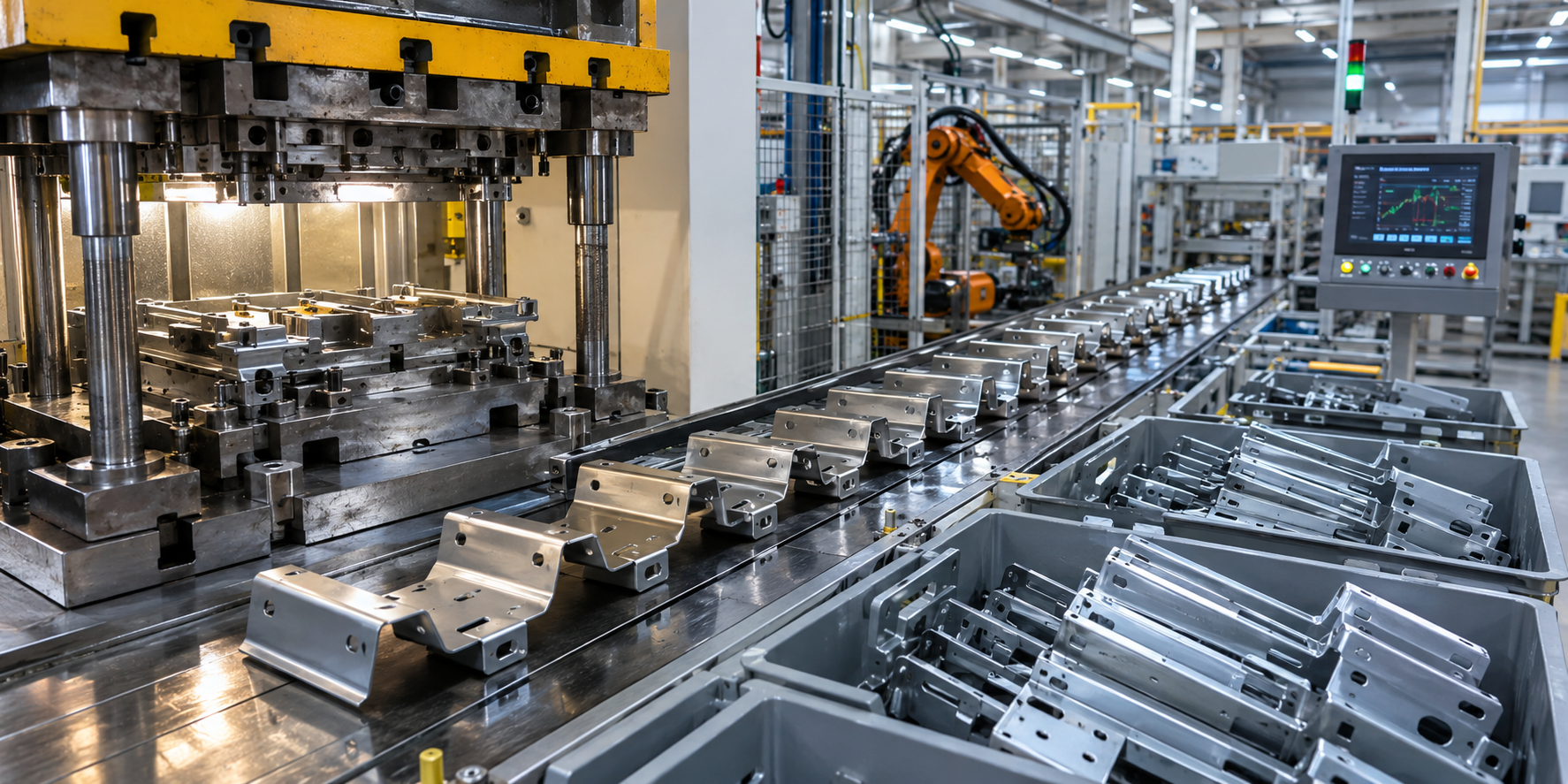
Automotive launch windows leave little room for tooling or production instability. This EV bracket program required both fast industrialization and a disciplined quality plan because the parts fed directly into a battery system assembly sequence with limited buffer.
The geometry was not exotic, but the combination of material thickness, forming consistency, and volume pressure made tooling readiness the critical success factor.
Solution Snapshot
We accelerated progressive die development, aligned PPAP documentation early, and built a launch control plan that tied press parameters, inline checks, and outbound audit criteria together from day one.
Launch risk at volume
The client’s timeline demanded tooling completion, sample validation, and process capability review inside a compressed window. At the same time, the bracket had to hold form and hole relationships reliably enough for downstream automated assembly.
A late tool correction would have created a direct risk to SOP, so the development path needed strong front-end control.
- High monthly demand with limited ramp tolerance.
- Automotive documentation and PPAP expectations.
- Dimensional consistency needed for downstream assembly automation.
Tooling and control plan
We structured the progressive die build around fast review loops with the client’s engineering team and defined inspection checkpoints for strip progression, formed geometry, and critical hole location. Early sample feedback was folded into the tool before mass-volume release.
Press setup windows, maintenance intervals, and first-piece approval rules were standardized so that shift changes would not introduce unnecessary variability.
- Accelerated tool validation with structured feedback gates.
- Standardized press setup and maintenance routines.
- Automotive-style control documentation from pilot phase onward.
Program impact
Once production stabilized, the customer gained not only capacity but a more predictable cost structure. The bracket family became easier to forecast because scrap, setup loss, and quality escapes were controlled at the source.
This gave the tier supplier confidence to lock future EV-related metal stamping work into the same manufacturing model.
- Stable high-volume output after launch.
- Clear operational data for future sourcing decisions.
- Platform for repeat automotive stamping work.