Many cost-reduction projects fail because the part is optimized without revisiting the tool strategy. In this case, the best answer was not a small geometric change but a new production architecture that matched the customer’s actual annual demand.
The enclosure served an electronics application where appearance, fit, and assembly feel mattered just as much as piece price. That required careful balancing between efficiency and visual consistency.
Solution Snapshot
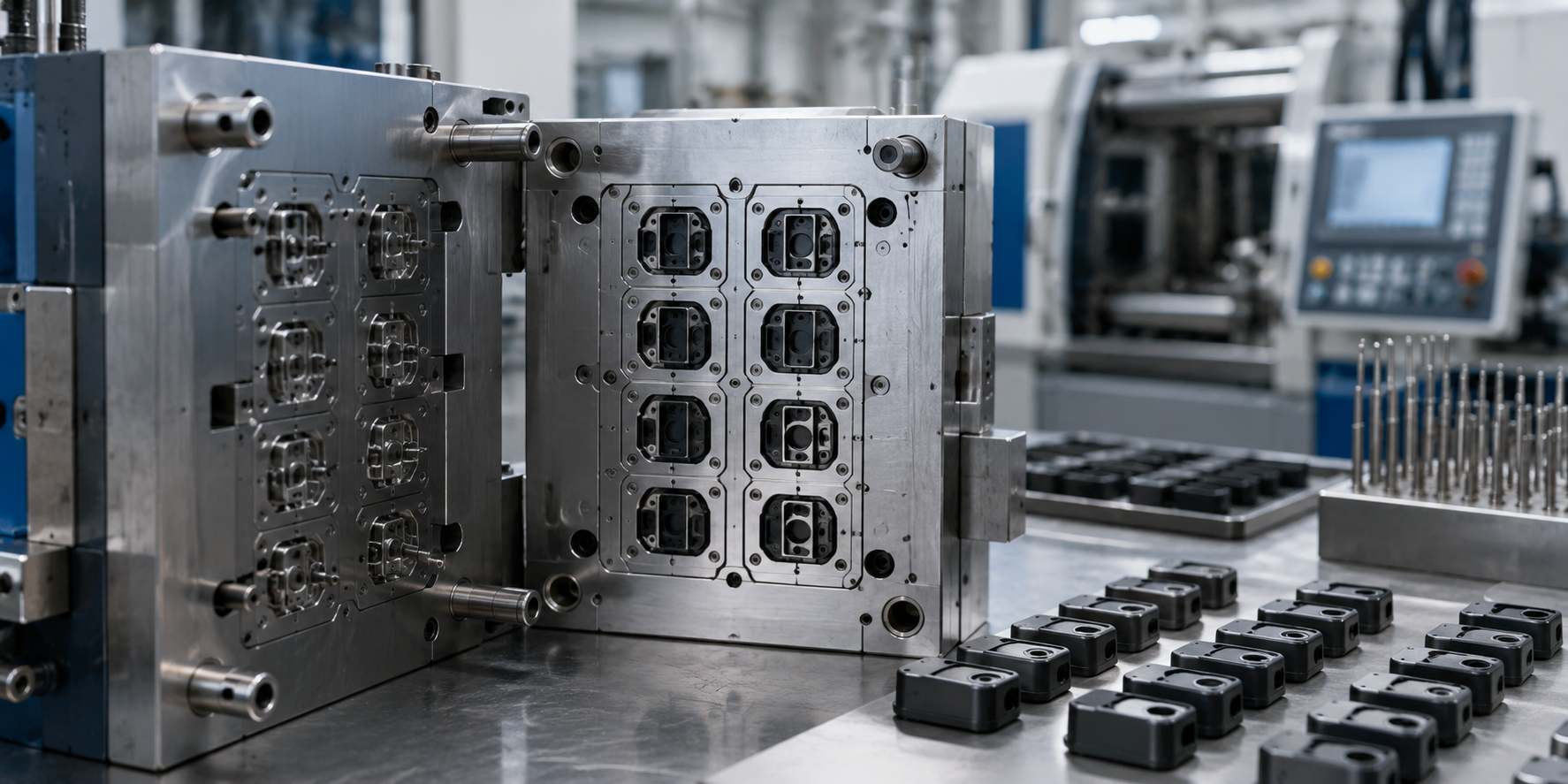
We redesigned the tooling strategy around an 8-cavity layout, balanced gating, and disciplined validation of cosmetic surfaces and clip performance before serial release.
Why the original tool no longer worked
The client had outgrown the economics of a low-output molding setup. Cycle time, labor allocation, and machine utilization made the old route increasingly inefficient as annual demand climbed.
At the same time, the part contained snap features and visible surfaces that limited how aggressively cost could be chased without affecting user-perceived quality.
- Legacy tool architecture mismatched to production volume.
- Snap-fit performance and cosmetics both mattered.
- Cost target required rethinking the whole molding strategy.
Tooling redesign and validation
We moved to an 8-cavity tool layout with balanced fill behavior and defined checks for cavity-to-cavity consistency. Cosmetic approval standards, assembly trials, and dimensional validation all happened before the full volume ramp.
This prevented a common failure mode in multi-cavity programs: reducing unit cost while silently introducing cavity variation.
- Balanced multi-cavity design to protect consistency.
- Cavity-to-cavity validation before production release.
- Assembly-fit checks integrated into launch approval.
Commercial result
The customer hit its cost target without needing to accept weaker visual quality or unstable clip behavior. More importantly, the new tool gave the brand room to scale future demand without reopening the sourcing decision.
This case became a model for how to evaluate tooling ROI in other plastics programs with high annual volume.
- Lower piece price with preserved user-facing quality.
- Improved scalability for future demand growth.
- Clear ROI case for multi-cavity investment.