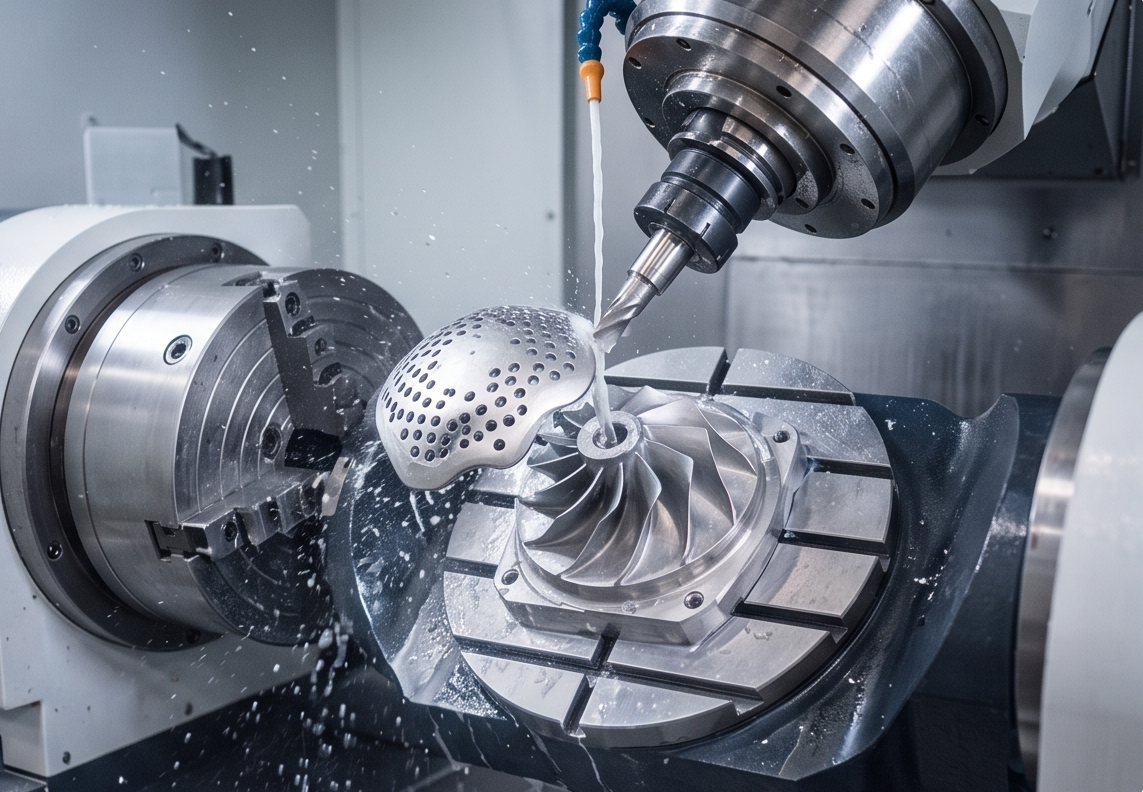
Propulsion components sit at the intersection of geometry complexity and performance sensitivity. For this project, every machining decision had an aerodynamic consequence because blade profile consistency affected balance, efficiency, and downstream test confidence.
The customer needed a partner who could manage titanium intelligently, not simply machine it expensively. That meant the route had to account for heat, tool engagement, workholding stability, and inspection from the beginning.
Solution Snapshot
We built the process around 5-axis machining, short-tool access strategy, staged semi-finishing, and structured CMM validation to protect blade geometry and hub relationships through the full route.
Geometry and material difficulty
The impellers featured thin blade structures, demanding surface continuity, and critical interfaces that had to remain stable after multiple machining stages. Titanium amplified every risk by increasing tool wear sensitivity and thermal load.
Any compromise in tool access or setup stability would have shown up as variation in blade form or positional drift at the hub features.
- Complex freeform geometry with high inspection sensitivity.
- Titanium material behavior increased process risk.
- Low-volume production still required serial-grade repeatability.
5-axis execution model
We used a 5-axis route to minimize repositioning and keep cutter reach short across the blade surfaces. Semi-finishing and finishing were separated deliberately to stabilize material behavior before final passes.
Inspection points were inserted between major stages so that any drift would be caught before value-added finishing time accumulated on the part.
- Fewer setups to protect feature relationships.
- Shorter tool engagement for better surface and dimensional control.
- Inter-stage CMM checks to catch drift early.
Why the customer stayed
The real win was not just the first accepted run. It was the customer’s confidence that future propulsion variants could be industrialized using the same process discipline. That reduced development friction for later programs.
The project demonstrated that a low-volume aerospace-style part could still be managed with production-grade rigor when the process was designed correctly.
- Higher confidence for future propulsion design variants.
- Reduced engineering escalation during build cycles.
- Production discipline applied to advanced prototype programs.